




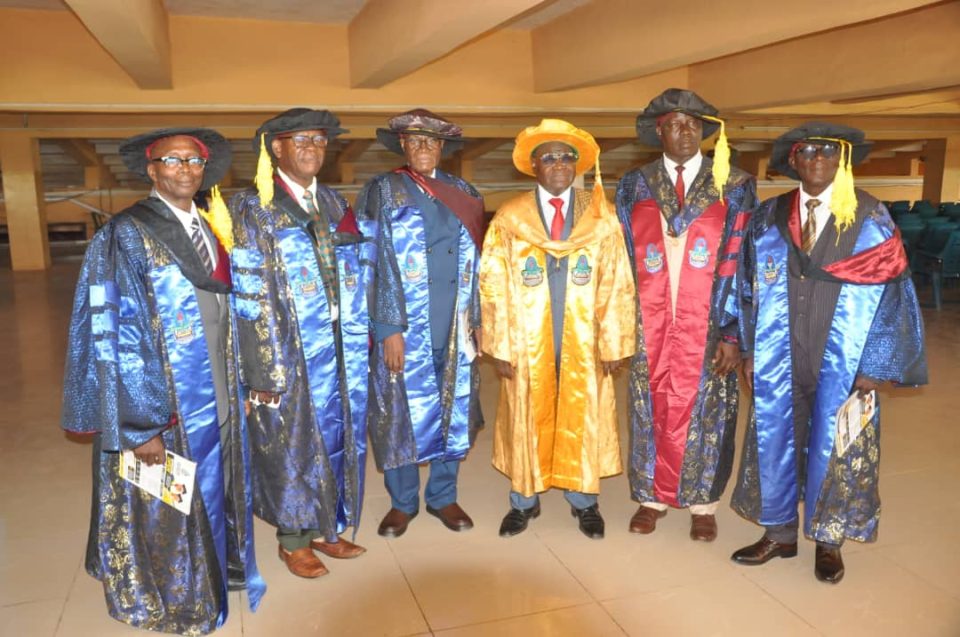
Dr Alban Igwe, Director-General, Dangerous Goods Academy, Nigeria, has urged Nigerian universities to move beyond conventional academic models and produce graduates capable of developing bankable solutions to local challenges.
Igwe made the call while delivering the 18th Convocation Lecture of Crawford University, Igbesa, Ogun, with the theme: “The Future of Crawford University: Globalising the Locals and Globalising the Global”.
He said universities must become innovation centres that understand their immediate environments, research their peculiar challenges and deploy global knowledge and technology to develop solutions with international relevance.
Igwe, an infrastructure strategist, transport economist and maritime lawyer said academic institutions should move away from the traditional emphasis on theoretical research and encourage students to develop practical, investment-ready proposals addressing societal problems.
“I am looking for a university that is not copy and paste, and does not ask you to do the traditional thesis.
“The university should asks students to provide bankable proposals as a project and becomes guarantors to the students who deliver solutions to local problems.
“That’s the university of the future. Because we don’t need to go to Harvard to solve a local problem in Igbesa. There’s markets in Igbesa,” he said.
Igwe stressed that universities must establish stronger connections with their immediate communities, adding that their impact should be reflected in practical interventions addressing local economic, environmental and social challenges.
He cited malaria as an example, challenging researchers to investigate its causes within their communities and explore indigenous medicinal resources and other locally available materials for possible solutions.
According to him, Nigerian universities must begin to look inwards, develop indigenous innovations and reduce dependence on imported solutions, which are often more expensive.
The convocation lecturer also advocated the integration of advanced technology into university education, saying it could facilitate international academic collaboration without requiring physical movement.
He said Nigerian lecturers could share local knowledge with students in foreign universities, while international scholars could deliver lectures to Nigerian students through technology-enabled platforms.
Igwe urged Crawford University to redesign its curriculum to incorporate local realities and international experiences, enabling graduates to compete effectively in the global economy.
He said such exposure would produce graduates who were not only locally relevant but also globally competitive.
“Those insights will enable our universities to evolve. A Crawford University graduate can interact with a Kenyan graduate or someone who studied in Egypt and compare notes.
“That way, a Crawford University graduate who passes through Crawford for four years and has experience of Egypt, Kenya and South Africa is no longer a local graduate. He is a localised graduate,” he said.
Igwe identified logistics and transportation as major areas through which Crawford University could distinguish itself, given its strategic location within the Lagos-Badagry-Cotonou industrial and commercial environment.
He described Igbesa as an important logistics corridor, urging the university to establish a centre for trade, logistics and supply-chain studies to harness opportunities within the surrounding industrial ecosystem.
According to him, the university could transform the Lagos-Kano-Jibiya (Lakaji) Corridor into a living laboratory where students and researchers investigate trade movements, transportation challenges and economic opportunities.
He said students of economics could examine trade-route economics, while those in computer science, agriculture, business administration and law could develop solutions relating to supply chains, commodity movements and cross-border trade regulations.
Igwe said logistics had become a major determinant of national competitiveness, noting that the World Bank’s Logistics Performance Index provided an important framework for assessing countries’ efficiency in moving goods.
He cited Singapore as an example of a country that had leveraged efficient logistics to strengthen its food security despite its limited agricultural production capacity.
The maritime lawyer argued that transportation was central to the functioning of virtually every sector, including healthcare, agriculture, education, commerce and national security.
He said disruptions to transportation could paralyse economic activities, regardless of the level of development in other sectors.
“Countries are competing by virtue of logistics only. If you want to grind any economy, just stop transport. Nobody goes anywhere.
“The Army doesn’t win war because of AK-47. They win war because of logistics,” he said.
Igwe proposed the establishment of a Crawford-Lakaji Knowledge Corridor to connect the university with industries, agriculture, manufacturing, ports, logistics, technology and global markets.
He said the initiative would create a two-way knowledge exchange in which industries presented practical challenges to the university, while researchers and students developed innovations to address them.
According to him, the initiative would position Crawford University as an intellectual and entrepreneurial hub, transforming research findings into marketable products, services and investment opportunities.
He said the university’s future competitiveness would depend on its ability to generate knowledge and translate it into practical economic value.
Earlier, Prof Solomon Makinde, the Vice-Chancellor of Crawford University, urged the graduands to become worthy ambassadors of the institution.
He restated that the graduands had been equipped with academic knowledge, wisdom and godliness.
He said the university expected its graduates to distinguish themselves through excellence and responsible conduct, expressing confidence that the graduating class, tagged Unicorn 18, would achieve remarkable success.
Also, Rev. Isaac Adigun, Proprietor of Crawford University and District Superintendent of the Apostolic Faith Church, West and Central Africa, called for collective efforts to raise graduates with sound academic and moral values.
Adigun said tertiary institutions must complement academic training with character development, noting that knowledge without godliness could contribute to corruption and other societal problems.
He said Crawford University had institutionalised Bible studies, prayer meetings and other faith-based activities to instil discipline, integrity and the fear of God in its students.
According to him, the university’s motto, “Knowledge with Godliness”, reflects its commitment to producing graduates who would deploy their expertise responsibly in society.
NAN reports that the 18th Convocation of Crawford University produced 630 graduands, comprising 528 undergraduates and 102 postgraduate students.
Of the undergraduate graduands, 54 obtained First Class Honours, 233 graduated with Second Class Upper Division, 191 earned Second Class Lower Division, while 50 obtained Third Class Honours.
The First Class and Second Class Upper Division graduates accounted for 287 students, representing approximately 54.5 per cent of the undergraduate graduating class.
The postgraduate graduands comprised 57 Master of Science recipients, seven Master of Business Administration graduates, 21 Postgraduate Diploma holders and 17 Doctor of Philosophy recipients.
Ibazebo Anthony Eromonsele of Computer Science and Technology and Njoku Chiamaka Jasmine of Biochemistry emerged joint best graduating students in the regular undergraduate programme, each recording a Cumulative Grade Point Average of 4.92.
Uzoma Perpetua Ndidiamaka of Physics with Electronics emerged the best graduating student in the School of Part-Time Studies, with a CGPA of 4.96.
