




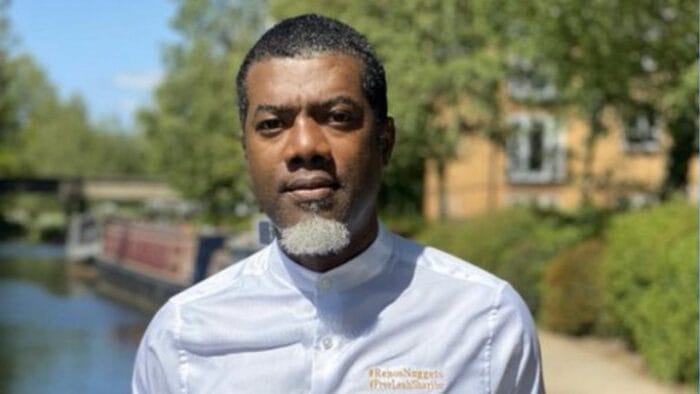
Public affairs analyst and security commentator, Femi Oyewale, has defended former Chief of Army Staff, Lieutenant General Tukur Buratai (retd.), against criticisms by former presidential aide, Reno Omokri, accusing him of taking a narrow and incomplete view of the retired military officer’s recent comments on Nigeria’s worsening security situation.
Oyewale said Omokri’s response focused on a single statement made by Buratai during a television interview while ignoring the broader context and substantive recommendations contained in the former Army Chief’s assessment of the country’s security challenges.
Buratai had spoken on TVC News following the recent abduction of schoolchildren and teachers in Oyo State, where he offered a detailed analysis of the factors fueling insecurity and outlined practical measures for addressing the problem.
Reacting to Buratai’s remarks, Omokri argued that the retired General underestimated the complexities involved in tracking and neutralising terrorists and bandits, citing the prolonged global manhunt for Al-Qaeda leader Osama Bin Laden as evidence that even advanced nations struggle to locate high-profile criminal actors.
However, Oyewale maintained that Omokri’s intervention missed the central thrust of Buratai’s message.
According to him, Buratai’s comments were never intended to disparage the Nigerian Armed Forces or other security agencies but rather to encourage greater effectiveness in intelligence gathering, inter-agency cooperation and operational deployment.
“General Buratai’s comments have unfortunately been taken out of context. Reno Omokri isolated one statement and built an entire argument around it while overlooking the broader issues raised by the former Army Chief regarding political complicity, intelligence coordination, security funding and community engagement,” Oyewale said.
He noted that Buratai, who remains one of Nigeria’s longest-serving Chiefs of Army Staff in the democratic era, has consistently defended the Armed Forces and remains an unwavering advocate of the sacrifices being made by military personnel across various theatres of operation.
“General Buratai is among the strongest defenders of the Nigerian military. Nobody who understands his record can reasonably suggest that he was attacking the Armed Forces. His observations were intended to strengthen ongoing security efforts, not undermine them,” he added.
Oyewale pointed out that beyond discussing the issue of tracking criminal elements, Buratai highlighted what he described as the disturbing role of some unscrupulous political actors who allegedly benefit from insecurity and exploit criminal groups for political purposes.
According to Buratai, some politicians recruit and empower local thugs during election cycles, only for such elements to later evolve into bandits, kidnappers and insurgents who terrorise communities.
The analyst also referenced Buratai’s observation that security challenges often intensify during periods of political transition when administrative changes create operational gaps that criminal groups exploit.
“One of the key points General Buratai made was that insurgent and criminal networks often take advantage of transitions between administrations. He warned that delays in decision-making and difficulties in accessing operational funding during such periods can create vulnerabilities that embolden criminal elements,” Oyewale stated.
He further explained that contrary to claims that Buratai advocated simplistic military action, the retired General specifically cautioned against rash rescue operations in kidnapping situations.
According to Oyewale, Buratai emphasised that hostage rescue missions involving schoolchildren require extreme caution because military action must be carefully balanced against the need to protect innocent lives.
“General Buratai clearly stated that rescue operations are delicate and that avoiding collateral damage must remain a priority. That position demonstrates strategic maturity, not recklessness,” he said.
Oyewale also recalled that Buratai strongly opposed the payment of ransom to kidnappers, warning that such actions only encourage further criminality and create incentives for future abductions.
The security analyst argued that Omokri’s attempt to portray Buratai’s intervention as an attack on the country’s security architecture was inconsistent with the overall tone of the retired General’s remarks.
He noted that the former Army Chief equally proposed far-reaching reforms, including the decentralisation of the National Security Adviser’s counter-terrorism framework to the state level, increased recruitment and training of security personnel, improved welfare packages for troops and stronger collaboration between government and local communities.
“These are not the comments of a man seeking to diminish the achievements of security agencies. These are the recommendations of a former military commander offering strategic solutions based on decades of experience in national security management,” Oyewale said.
He further argued that the operational successes cited by Omokri, including the arrest, prosecution and elimination of several notorious bandits and terrorists, actually reinforce Buratai’s position that Nigerian security agencies possess significant capabilities when intelligence and operational assets are effectively deployed.
“The irony is that many of the examples Reno Omokri cited in his defence of the security agencies actually support General Buratai’s argument. Those successes demonstrate capacity, and General Buratai’s position is that such capacity should be continuously strengthened and optimised,” he noted.
Oyewale urged Nigerians to approach security discussions with objectivity and avoid reducing complex national conversations to political point-scoring.
He stressed that Buratai’s intervention should be viewed as a patriotic contribution to ongoing efforts to address insecurity rather than a criticism of the men and women risking their lives to defend the nation.
“At no point did General Buratai disparage the Armed Forces. His message was clear: support the military, strengthen intelligence operations, address political enablers of insecurity, improve coordination among security agencies and adopt long-term strategies capable of defeating criminal networks.”
He added that constructive engagement with experienced security stakeholders would better serve the country’s interests than selective interpretation of comments made in good faith.
According to Oyewale, national security remains too important to be subjected to unnecessary controversy, especially when the underlying objective is the protection of lives, communities and the preservation of peace across the country.
