




Razornews Security Summit Calls for Stronger Inter-Agency Collaboration, Credits Oluwo of Iwo for Championing Traditional Leadership in National Security
“Oluwo of Iwo Champions Traditional Institutions as Pillars of Peace and Security”
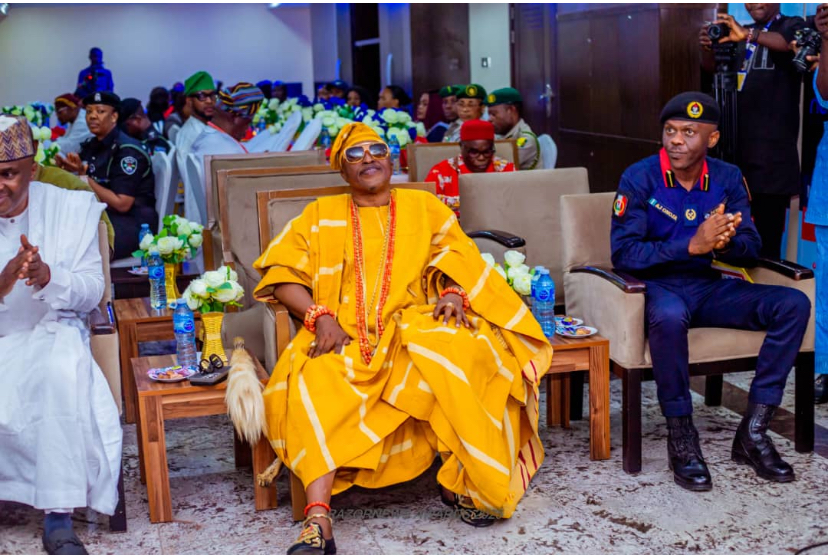
Stakeholders in Nigeria’s security sector on Tuesday renewed calls for stronger institutional collaboration as the backbone of counter-terrorism and crime prevention. The position was reinforced at a one-day inter-agency lecture and awards ceremony organised by Razornews in Lagos, with His Imperial Majesty, the Oluwo of Iwo, Oba Adewale Akanbi Telu I, serving as Chairman of the event and moral compass for the proceedings.
The conference, themed “Institutional Collaboration as a Tool for Counter-Terrorism and Crime,” held at the event hall of Shoregate Hotel, GRA Ikeja, brought together senior officers and key representatives from the Nigeria Police Force, Nigerian Immigration Service, Nigeria Security and Civil Defence Corps (NSCDC), Nigerian Correctional Service, Nigerian Customs Service, National Drug Law Enforcement Agency (NDLEA) and several paramilitary and safety institutions.
In his keynote role, His Imperial Majesty, the Oluwo of Iwo, Oba Adewale Akanbi Telu I, emphasised that security is fundamentally rooted in the community and that traditional rulers are the first line of intelligence, conflict mediation and peace-building. He stressed that governments must recognise and formally integrate traditional institutions into the country’s defence architecture, not as ceremonial custodians, but as active partners in grassroots policing and early warning systems.
The revered monarch stated that insecurity thrives where communities are neglected and security agencies compete rather than collaborate. He urged Nigerians to look beyond stereotypes, tribal suspicion and sensational narratives, reminding stakeholders that criminality has no ethnic identity, no faith, and no geographical monopoly.
“We must separate crime from ethnicity and culture. A criminal is a criminal regardless of origin. Traditional rulers see the people every day, we know the newcomers, we know who is troubled and who is a threat. Give us the responsibility, and collaborate with us. Traditional authority must drive community-based security,” the Oluwo declared.
His Imperial Majesty further advocated a national orientation that prioritises patriotism, community responsibility, and shared values over sectional sentiments.
Oluwo of Iwo stressed the urgent need to intensify cooperation among the nation’s security and law enforcement institutions, noting that fragmented efforts have historically emboldened criminal networks. He asserted that: No single agency can defeat terrorism, banditry, kidnapping, armed robbery and smuggling alone. Inter-agency collaboration must be continuous, not crisis-driven. Partnerships between state security agencies and community structures, including traditional institutions and vigilante networks, should be entrenched.
Oba Adewale further noted that Nigeria’s institutions were designed to work in synergy, but internal rivalry, lack of trust and bureaucratic bottlenecks had weakened their effectiveness.
The communiqué echoed Oluwo of Iwo’s position, calling for the formal recognition of traditional rulers as pivotal stakeholders in crime detection and communal security. Traditional leaders, it stated, must be empowered to: Identify and report criminal elements residing within their communities; Ensure community resources, especially land, are used equitably to promote welfare, food security and social stability.
Discourage acts of land grabbing, exploitation and exclusion which fuel resentment and crime. It called on traditional authorities to resist broad-brush stereotypes, noting that the misdeeds of a few individuals should not define entire ethnic groups. The example of Fulani pastoralists was highlighted: many lived harmoniously across southern Nigeria for decades; isolated incidents by criminal actors must not erase that history.
In a major policy proposal, participants suggested that the Federal Government consider conditional amnesty for armed bandits and terrorists willing to renounce violence, alongside structured education and reintegration for the largely illiterate militant population. The rationale is that ignorance, unemployment and drug abuse are primary drivers of violent extremism across the country.
Participants recommended that the military and police establish a central coordinating command, enabling real-time joint decision-making and rapid responses to security threats. The police, they said, must deepen direct engagement with communities to secure timely grassroots intelligence, especially in forested hinterlands where criminal gangs often operate.
A central message of the summit was that modern security cannot be defined solely by borders or territorial disputes. Rather, it must focus on citizens, culture, communities, religious leaders, traditional rulers, and civil society organisations. These non-state actors form the frontline of early detection, prevention and conflict mediation.
His Imperial Majesty, the Oluwo of Iwo, Oba Adewale Akanbi Telu I, spoke extensively on community-based peacebuilding and traditional conflict resolution, and was widely commended as a “guiding light” at the summit.
Rear Admiral O. A. Bankole (rtd), representing the former Chief of Defence Staff, General Christopher Musa, who affirmed the armed forces’ readiness for multi-agency security integration.
Commissioner of Police, Lagos State, CP Olanrewaju Moshood Jimoh, who represented the Inspector-General of Police, IGP Kayode Egbetokun, and reiterated the police force’s commitment to intelligence-driven operations.
Speakers unanimously acknowledged the Oluwo’s leadership role, describing him as an advocate for institutional harmony, cultural stability and inclusive nation-building.
The summit concluded with the presentation of awards to deserving officers and distinguished citizens for their contribution to national security, peace and stability. The recognition symbolised not just their personal achievements, but also the collective responsibility needed to secure Nigeria.
