




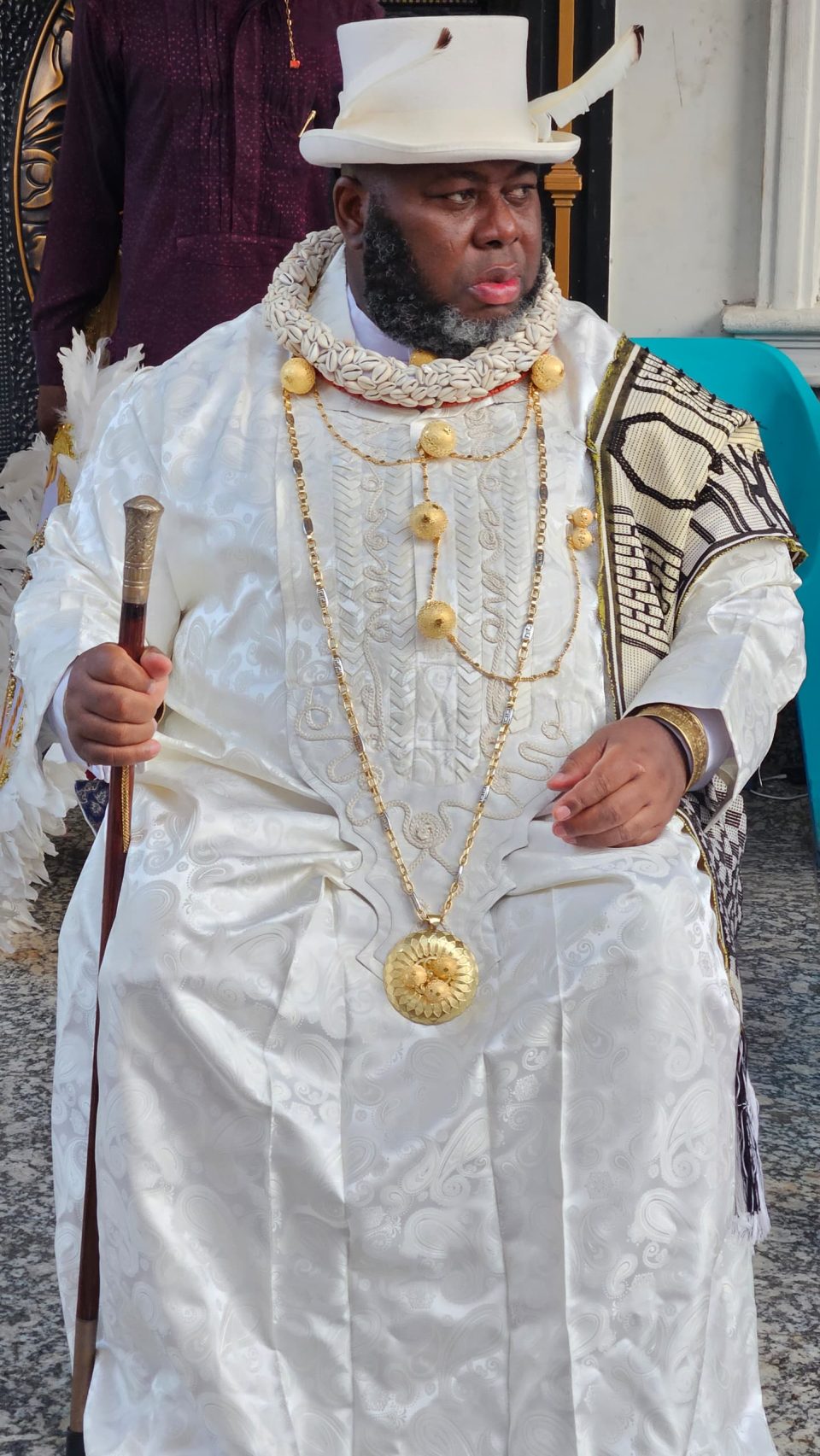
By: Al Humphrey Onyanabo
On the final day of Ramadan, inside the quiet elegance of the Transcorp Hilton in Abuja, I sat across from Da Amakiri Tubo,
Alhaji Mujahid Abubarkr Dokubo-Asari, Amanyanabo of the oil rich, Elem Kalabari,(The Source,) Torusarama Piri, Dabaye Amakiri 1,
a man many know for his strong voice, controversial positions, and unmistakable presence in Nigeria’s public space.
But beyond the politics, beyond the agitation, beyond the titles, there is a deeper force that defines him — faith.
What emerged in that conversation was not the rhetoric of a public figure, but the conviction of a man whose life is firmly anchored in Islam — not casually, not symbolically, but completely.
A Journey That Became Identity
For him, Islam was not an accident of birth.
It was a journey — one that began with curiosity but matured into total submission.
He spoke of a defining moment — a point where belief stopped being intellectual and became personal, consuming, and irreversible.
From Early Devotion to Spiritual Fulfilment
Long before his public identity took shape,
Alhaji Mujahid Abubarkr Dokubo-Asari was formed in a deeply religious Christian environment — on both his paternal and maternal sides.
To understand the depth of conviction that defines
Alhaji Mujahid Abubarkr Dokubo-Asari today, one must return to the beginning — to a childhood immersed not in Islam, but in an intensely religious Christian environment.
“I was born in an environment that is overtly Christian,” he begins, almost reflectively.
“My grandmother,
She was an Anglican, that’s my father’s mother, Da Amakiri Tubo, Okukuba Wilkinson Dokubo Goodhead, (Nee Ogo Tom Princewill )
who I lived with had a prayer altar where we pray every morning.”
That grandmother — a central figure in his early life — was deeply rooted in Kalabari Christianity, particularly the Teke.
“She believed so much in Kalabari Christianity, Teke. She was an Anglican… a member of St Michael’s Church. She also belonged to the Akasabianga Teke. The Akasabianga Teke was by the side and later, when the prophetess broke away and founded Elijah Teke… she moved.
Sometimes she even went to Obuama to attend Dee Teke.”
Faith, in that household, was not occasional — it was constant.
“Every day was one religious event or the other,” he recalls.
“We had morning devotion, we sang very thoughtful and meaningful Teke songs.”
Even his lineage reinforced that foundation.
“My grandfather, who I did not meet, was an Anglican catechist. He had this very big Bible… there were many other Bibles in the house.”
An Active Faith — But an Unanswered Question
Despite this deeply religious upbringing, his personal path within Christianity took its own direction.
“Though I was not living with my mother’s people, I was attracted more to the Baptist Church than the Anglican Church. I can’t remember, while growing up, any day I attended an Anglican church on Sunday.”
With the freedom his grandmother allowed, he immersed himself fully in the Baptist Church — not as a passive observer, but as an active participant.
“I attended their Sunday services, I took part in their youth activities, and I became a Sunday school teacher.”
His influence was real and traceable.
“There are so many people in the Baptist church today who passed through me. Rev. Dr. Damiete Amachree, pastor of the Agape Baptist church, Obuama, was one of my students.”
He smiles at the memory of a Ghanaian song he introduced during those years — one that still follows him among old companions.
Yet beneath the activity, something was unsettled.
“But I was empty.”
That emptiness persisted even as he deepened his involvement — from the Baptist Church to the Deeper Life Bible Church, and into leadership roles.
“I became President of the Students Christian Movement at Baptist High School, Port Harcourt. I saw people speaking in tongues… and I kept asking questions.”
Then came a moment that would mark a turning point.
“It was when General Sharon of Israel invaded a Palestinian refugee camp in Lebanon which was described as the Sabra and Shatila massacre on September 16 – 18, 1982
that I started questioning my Christian faith.”
His questions were not casual — they were direct, searching, and uncomfortable.
“I wrote to Pastor Kumuyi, the General Overseer, and I asked him: Your God, is He the one that created all of us? Why would He prefer one group of people over another?”
From that point, the certainty he once held began to erode.
“My faith in Christianity started going down. I was no more regular in church.”
Search, Experimentation, and Restlessness
What followed was not an immediate conversion, but a period of intense searching.
He explored Islam early, visiting a mosque in Port Harcourt as a teenager.
“I went to the Yoruba mosque at 16/17 Victoria Stree, Port Harcourt. I met someone, Alhaji Jimoh, who had a relationship with my Auntie, but his understanding of Islam was not very deep. What he told me was not very different from Christianity, so I refused to convert.”
Instead, he turned inward — constructing his own philosophical framework.
” I started preaching Godianism. I created a religion about the worship of Holy God,one spiritual entity and I developed my philosophy. People who did not understand my philosophy back then just like people are still doing today. In Godianism I said that God is One and God does not have a partner. ”
Looking back, he recognises the direction his thoughts were already taking.
“When I reflect now, I can say I was preaching Unitarian Islamic beliefs.”
Still, the restlessness remained.
He returned to church, entered the University of Calabar, and again became deeply involved in Baptist fellowship.
“I became very popular in the Baptist congregation at Calabar… but I was restless. I was not satisfied.”
Even his engagement with Marxism and student activism failed to fill the gap.
“I joined the Movement for a Progressive Nigeria, MPN… but Marxism did not give me spiritual satisfaction.”
The Turning Point: Discovery
Through Study
Then came a defining global event — the Iranian Revolution.
“The Iranian revolution made me start studying Islam.”
What followed was rigorous, almost obsessive intellectual inquiry.
“I went to the library, I spent hours reading… orientalist views of Islam, and I balanced it with what Islam says.”
But there was a problem.
“There were not so many books written by Muslims in our libraries… which is very unfortunate.”
So he improvised.
“I bought books on the road. I read
the Encyclopaedia Britannica… books written by people who are anti-Muslim.”
This was not passive learning. It was investigation.
Conversion and Transformation
On September 17, 1988, the search ended.
“I accepted Islam as my religion at the Bokobiri Mosque in Calabar. Not long after,
I had problems in school. I was rusticated.”
What followed was a period of physical hardship and spiritual clarity.
“I travelled through Nigeria… I stayed with Muslims. Even though I was from a very elitist and noble background, I subjected myself to all manner of things.”
The contrast was stark.
“From living in GRA, Port Harcourt ,Akassa street, to moving from one dirty mosque to another… sleeping in very poor conditions.”
Yet, in that hardship, something changed.
“I discovered I was getting satisfaction in my heart.”
Then came the defining declaration of faith.
“I took the Kalima Shahadah( Declaration of Faith) I found that my life was getting more and more organised.”
For the first time, the restlessness disappeared.
“I no more had the sort of spiritual restlessness I used to have as a Christian.”
A Faith That Answers the Search
Today, when he reflects on that journey, one conclusion stands firm:
“I have always been someone who likes to read, to explore, to innovate.”
And in that spirit of inquiry, Islam did not silence his questions — it answered them.
“I discovered through my studies that there is nobody who will read the Qur’an… even if you use the biggest padlock to lock your heart… and God will not touch you in one way or another.”
That, ultimately, is the foundation of his conviction.
“That was my journey to Islam.”
The discipline he had learned in his Christian upbringing did not disappear; it found new expression. The early morning prayers, the structure, the devotion — they remained, but now anchored in a conviction that felt whole.
And in that transition lies a key to understanding the depth of his present-day conviction.
Over the years, that faith has not remained static. It has deepened, sharpened, and shaped how he sees the world — particularly on issues of justice, power, and responsibility.
Islam, to him, is not just religion.
Whether he is speaking about his faith, Kalabari culture and tradition, the Niger Delta struggle, or the complexities of Nigerian politics, he does so with an abundance of knowledge, depth, and unmistakable conviction. There is no half-measure in his engagement with any subject.
What stands out even more is his command of detail. Dates, events, names, and sequences roll off his tongue with precision, as though each moment has been carefully archived in his mind. It is not rehearsed — it is lived.
In conversation, he does not merely respond; he immerses. He builds context, draws connections, and anchors his arguments in both history and principle. The effect is disarming — you find yourself drawn in, often spellbound, not just by what he says, but by how completely he inhabits it.
It is this rare combination — conviction, depth, and total immersion — that sets him miles apart from the crowd.
Faith as Compass in Controversy
His outspoken support for global Islamic positions — including his controversial alignment with Iran — has drawn criticism, misunderstanding, and even coordinated misinformation, including fabricated AI videos portraying his arrest.
Yet, he remains unmoved.
There is a clarity in his stance that comes from conviction, not convenience. He does not negotiate belief to fit public approval.
That, perhaps, is where many find him difficult — and where others find him deeply compelling.
The King and the Believer
As Amanyanabo of Elem Kalabari, his role sits at the intersection of tradition and faith — a space that often demands compromise.
But he does not see the contradiction.
“When you become Amanyanabo something happens to you: I have to restore all the shrines at Elem Kalabari, because they were there before us, I have to restore the church, The Kalabari National Church, and I have to build a mosque. There is so much activity. All these things spiritually sets you back. In those days I used to read the Qur’an daily. But now I only recite the ones I learnt long ago.
Sometimes, it worries him that he has lost some of his zeal for knowledge and learning to activism and community growth
“When I became a Muslim, I became voracious to read. I wanted to know more, so I thought myself Quoran, I taught myself to read Arabic, nobody taught me. All the recitations I am doing now, they are things I taught myself years ago.
I went out to Maiduguri where I had a friend, Abubarkar Imam, who later became the Grand Kadir I think. And he took me to his village in Gambori where I stayed for sometime. And I became known to so many people in Bornu state, Sherrif…to so many people, to all the Shieks, Sherrif Hussain, Abdulfarhi, traditional rulers…the chief of Ghoza, Shehu Bornu, Emirs and so on, most of them are dead now.
I did a lot of spiritual exercises, but as I started getting involved in community activities, my involvement in Muslim activities started to drop.
Movement for The Ijaw Ethnic Nationality in the Niger Delta, Ijaw National Congress,INC, before then, we had what we call , Committee of Collective Conscience, a group with ideology leaning towards Marxist- Lennism. From there to MOSIEN and then the Ijaw Youth Council, IYC.
With activism and being involved in Kalabari way of life and becoming a chief eroded in me some of the zeal and workaholic style of trying to know everything.”
The values he draws from Islam — justice, discipline, accountability — are not abstract ideals. They are operational principles. These values have made him a champion amongst his kinsmen.
Islam he says has shaped his world view as it pertains to justice and leadership.
“Let me give you a scenario, in my compound, normally people sit down and give judgement. The practice was that you drop money when you have a case. As head of the Edi Abali Group of War Canoe Houses, things have changed.”
He continues,
“People come, we settle them and they go. And because they are afraid of me, they know I can sanction them, when I say go one direction, they go. And there is peace.
Court cases he reveals has dropped to almost Zero in his compound.
” Invocation of JuJu, cultism, drunkenness have dropped, and I introduced free education from nursery to university. At least your tuition is paid. In Omubobrinomoni, that is another level of chieftaincy, they always wait for me to give my views. When the late Amanyanabo, Theophilus Princewill was alive, if they are judging a case and I enter, some people will go and whisper in the ear of the person presiding, he has come oh, he has come oh, and they will ring the bell that the case is adjoined. They are adjoining the case because they know that my views will be for Justice.
Islam, he reveals has made him to stand for justice and it is acclaimed,
” Everybody knows it.
The Kalabari state, gathered and made me, Da Amakiri Ekpeke, the shield of King Amakiri, the Kalabari state also made me Sebromabo, The Messiah, the Saviour of the Kalabari People, And this is evident. Today, Kalabari people can travel freely. For four years, nobody is kidnapping them, nobody is killing them. People travel freely.”
Discipline Beyond Display
There is a noticeable rigor in how he practices his faith. It is not performative. It is structured.
Daily prayers, fasting, study — these are not obligations he struggles with; they are rhythms that sustain him.
During Ramadan, that discipline intensifies — but more importantly, it refines.
For him, Ramadan is not just about abstinence. It is about realignment — a return to purpose, humility, and submission.
Faith in a Divided Society
In a country as religiously complex as Nigeria, his position is both firm and deliberate.
He does not dilute belief in the name of coexistence — but neither does he preach conflict.
To him, Islam already provides the framework for peaceful coexistence — rooted in justice, responsibility, and respect.
A Personal Code That Attracts Others
There is something else — something less obvious but equally powerful.
His faith is not only declared. It is lived.
And that has influence.
Quietly, consistently, people around him are drawn — not by pressure, but by example.
A life of structure. A life of conviction. A life that does not bend easily.
A Moral Environment Defined by Discipline
Spending time around
Alhaji Mujahid Abubarkr Dokubo-Asari leaves a clear and lasting impression — not of excess or indulgence, but of restraint, order, and a firmly held moral code.
There is an unmistakable shift in atmosphere in his presence.
Conversations are measured. Language is deliberate. There is a natural restraint in speech, not imposed, but understood.
People adjust — not out of fear, but out of awareness of the standards he represents.
His environment reflects the same discipline.
There is no tolerance for alcohol.
No space for cigarettes.
No trace of the careless social culture that often surrounds power and influence.
Notably, there are no written rules plastered on the walls — no “No Smoking” or “No Alcohol” signs. None are needed. Those who come into his space already understand what is acceptable and what is not.
His stance is well known, and it is respected.
And so, people do not bring such things near him. It did not start yesterday. People who have been with him for upwards of 25 years confess his standards have never waivered, he can crack jokes and make everyone laugh on general subjects, he can recall things done by his boys at different times and everyone laughs over it, but the unseen lines are always there.
Don’t bring anything criminal to him, don’t try luring him with money. Contentment with a clear conscience has always been his watchword.
It extends beyond substances. There is also a clear rejection of loose living and moral laxity. The environment he maintains is intentional — one that reflects discipline, modesty, and self-control.
This is not about image. It is about alignment.
A man who speaks about faith with conviction, he has chosen to live in a way that does not contradict it.
And in that consistency lies the quiet authority that defines him.
Mentors, Scholars, and the Example of the Prophet
When the conversation turns to influence — to the figures who have shaped his thinking, strengthened his faith, and guided his worldview —
Alhaji Mujahid Abubarkr Dokubo-Asari does not hesitate.
At the centre of it all is one figure whose life, he says, defines everything he strives to be: Prophet Mohammed.
He speaks with intensity, deep reverence, his words measured but deeply felt.
“Everything about the life of the Holy Prophet Mohammed resonates with me… and I copied it based on the Qur’an. His rise… and among religious leaders, Prophet Mohammed was the most humble.”
For him, the distinguishing quality is not just leadership, but humility — a humility he believes sets the Prophet apart across history.
“He tells the world, ‘On my own, I am nobody, everything is Allah. If Allah decides about me, nobody can change it.’
He is unlike other religious leaders who make all manners of claims… we are in this world and we are seeing that their claims do not hold water.”
It is not admiration from a distance. It is a deliberate attempt at imitation.
“He was humane, he was a great man, and everything about his life — that is what I want to live, that is what I want to emulate.”
Guided by Mentors, Strengthened by Companions
Beyond the Prophet, his journey has been shaped by individuals who played practical roles in strengthening his understanding of Islam.
He lists them without hesitation, each name carrying weight.
“Yes, I have mentors like Alhaji Kunle Sanni, Mallam Idris, Prof. Gbadamosi, Alhaji Ekungba, Alhaji Abubakar Imam… and several others.”
But among them, one stands out above the rest.
“Most of them I met through Alhaji Kunle Sanni, who I will say is the greatest person in my life as a Muslim.”
The Scholars Who Shaped His Thinking
His intellectual influences are just as deliberate — drawn from some of the most profound minds in Islamic history.
“The Muslim scholars that have influenced me are Imam Ghazali, Said Qutb of Egypt, and Hassan al-Banna.”
He expands further, drawing distinctions in their contributions.
“I have read the works of Imam Maududi… he and Said Qutb are almost similar, but Said Qutb is the master of shaping a modern Islamic state.”
His analysis is not superficial — it reflects years of study, comparison, and internalisation.
“The deviation from the preaching of the Prophet Mohammed is the introduction of monarchy in Muslim lands… so the scholars that have influenced me in life are Imam Ghazali… the inner dimensions of Islam, then Said Qutb, Hassan al-Banna, and Imam Maududi.”
Identity Without Conflict.
Given the depth of his Islamic conviction, one might expect a tension between faith and cultural identity. He rejects that entirely.
“I don’t need to balance anything. God created me as a Kalabari man. He did not create me an Arab, so I am not going to be an Arab.”
For him, identity is not a contradiction to be managed — it is a reality to be accepted.
“I a
