




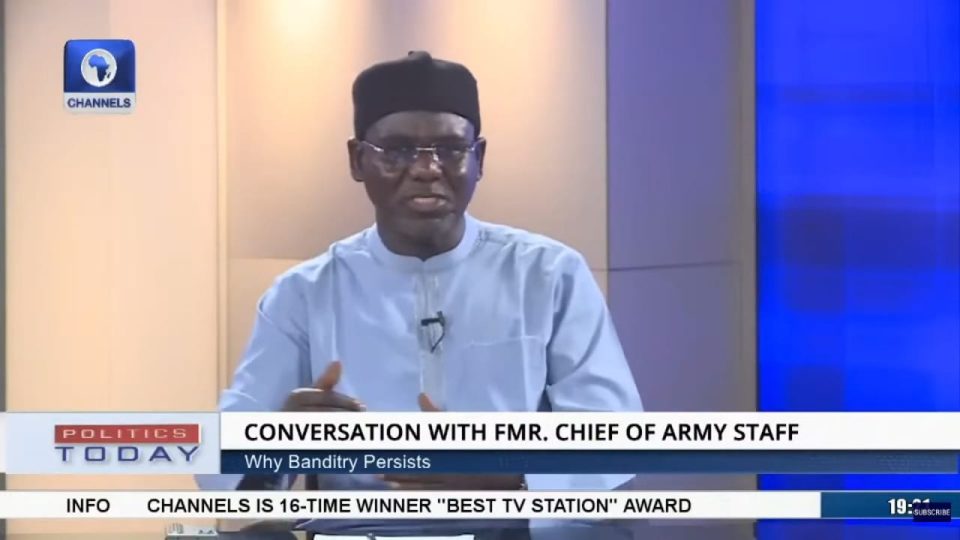
Former Chief of Army Staff, Lieutenant General Tukur Yusuf Buratai, has outlined key factors sustaining insurgency in Nigeria, warning that while progress has been made, the conflict may persist unless a comprehensive national strategy is fully implemented.
Buratai spoke during an in-depth interview with Seun Okinbaloye on Channels Television, where he examined the country’s counter-insurgency efforts, challenges facing the military, and the path forward.
Presidential Directive and Renewed Focus
The retired army chief described President Bola Ahmed Tinubu’s directive for service chiefs to relocate to Borno State as a strategic move aimed at strengthening frontline command in the fight against insurgency.
He said the directive signals renewed commitment but raised critical questions about whether such measures alone can significantly alter realities on the ground.
Insurgency Rooted in Decades-Long Evolution
Buratai traced the origins of insurgency in Nigeria to earlier extremist movements in the 1980s and 1990s, which later evolved into the Boko Haram crisis.
According to him, the conflict has spread beyond the North-East to parts of the North-West and North-Central, making it a prolonged and complex national security challenge.
“Military Not Overwhelmed, But Needs More Support”
Despite ongoing attacks, Buratai maintained that Nigerian troops are not being overwhelmed. He noted that the military now operates with improved technological capabilities, including armed and surveillance drones, compared to earlier years.
However, he stressed that significant gaps remain in equipment, manpower, and operational resources.
Key Challenges: Terrain, Troops, and Fatigue
The former army chief identified major operational constraints, including the vast terrain of the North-East, limited troop numbers, and harsh environmental conditions.
He added that soldiers often face fatigue, resupply difficulties, and insufficient rest, all of which affect combat efficiency.
Confidence in Current Military Leadership
Buratai expressed confidence in the current security leadership, including the Chief of Defence Staff and other service chiefs, noting their recent visits to conflict zones following presidential directives.
He also acknowledged the involvement of the police leadership in supporting security operations.
Why Insurgencies Take Decades
Drawing comparisons with global conflicts, Buratai noted that insurgencies in countries like Colombia and Sri Lanka lasted several decades, emphasizing that such conflicts are rarely resolved quickly once entrenched.
He described insurgency as a “people’s war” requiring collaboration between the military, intelligence agencies, government institutions, and civilians.
Clarifying “Technically Defeated” Boko Haram
Buratai addressed past claims that Boko Haram was “technically defeated,” explaining that the term reflected a significant reduction in attacks and recovery of territories between 2016 and 2018.
He noted that prior to that period, bombings were frequent and widespread, but military operations successfully degraded the group’s territorial control and operational capacity.
Whole-of-Society Approach Essential
The former army chief emphasized the need to fully implement Nigeria’s 2019 National Security Strategy, which promotes a whole-of-government and whole-of-society approach.
He said military gains must be supported by development efforts such as infrastructure, job creation, and social services to prevent insurgents from regaining footholds.
Controversy Over Terrorism Financing
On the issue of terrorism financiers, Buratai stated that identifying and naming suspects is not the responsibility of the military but of other security and intelligence agencies.
He added that while intelligence exists, the real challenge lies in prosecution and decisive action.
Debate Over Rehabilitation of Ex-Insurgents
The retired general clarified that the rehabilitation of repentant insurgents was a government policy, not solely a military initiative.
While acknowledging criticisms, he maintained that individuals accused of serious crimes should undergo investigation and legal processes, suggesting that the policy may require further review.
Urgent Recommendations
Buratai called for immediate steps to strengthen Nigeria’s security architecture, including:
Increasing troop numbers, particularly in the North-Eas
t
Establishing more permanent military bases in reclaimed areas
Expanding the use of drones and modern technology
Addressing military overstretch across multiple regions
Intelligence and Technology as Game Changers
He stressed that intelligence gathering remains the most critical aspect of the war, urging authorities to identify and dismantle networks of informants and collaborators aiding insurgents.
Buratai cited Colombia’s strategy of targeting urban support networks as a model Nigeria could adapt.
Internal Military Concerns
Addressing reports of discontent among some officers, Buratai linked such issues to career progression concerns, emphasizing the need for continuous engagement, training, and motivation within the armed forces.
Final Outlook
Buratai concluded that while Nigeria faces significant security pressures across multiple regions, the insurgency is not insurmountable.
He maintained that success will depend on sustained military investment, improved intelligence coordination, technological advancement, and active participation of all sectors of society.
